

Neurodivergent Therapy in Scottsdale, AZ
Practical Skills for Practical Brains
In Scottsdale and online throughout Arizona, Colorado, Florida, and Nevada
Maybe you’ve spent years wondering why things that seem easy for everyone else take so much damn effort.
You know what you’re supposed to do. You’ve bought the planner. You’ve made the list. You’ve tried harder. And somehow you’re still overwhelmed, running late, avoiding the thing, forgetting the thing, or wondering why you need to psych yourself up for going to the store.
Or maybe you’ve gotten really good at holding it all together—until you get home and have absolutely nothing left. So you explode or burnout and spend 3 days on the couch.
Neurodivergent therapy isn’t about teaching you how to be better at pretending your brain works differently than it does.
We figure out what’s actually getting in the way, what works for your brain, and how to make your life a little easier to live.
I work with ADHD and autistic adults, including people who were diagnosed later in life and people who are still figuring out whether neurodivergence might explain some of the things they’ve struggled with for years. You don’t need a formal diagnosis to work with me.
What Can Neurodivergent Therapy Help With?
Being neurodivergent can affect much more than attention or organization. You may have spent years developing ways to compensate, mask, push through, or work around things that seem to come more easily to other people.
Therapy can help if you're struggling with:
Executive functioning, procrastination, or getting started on tasks
Feeling overwhelmed and/or overstimulated
Sensory sensitivities
Time management and organization
Emotional regulation
Communication or conflict in relationships
Social anxiety or exhaustion
Masking and burnout
Boundaries and people-pleasing
Understanding yourself after a late ADHD or autism diagnosis
It doesn’t matter if you see your neurodivergence as either a “superpower” or a problem, or both. We focus on the parts of your life that aren't working the way you want them to and leave the rest alone. A diagnosis can help provide context, but it doesn’t define you as a person or what you want in your life.




What Therapy With Me Is Like
Therapy with me is active, collaborative, and practical. You won't find me sitting silently and nodding for 50 minutes while you question if you’re even doing therapy “correctly.” My own neurodivergent brain would get way too bored sitting silently for that long anyway. 😆
We'll figure out what's actually getting in the way, work through the deeper stuff when we need to, and come up with strategies you can actually use outside of therapy. I’m not going to tell you to “just use a planner” or give you a list of coping skills you’ve already tried twelve times.
I have nearly 20 years of combined experience in education and clinical work, much of it focused on ADHD, autism, relationships, and neurodivergence. That means I understand that sometimes the problem isn’t that you don’t know what to do—you often know exactly what to do. Sometimes the problem is figuring out how to actually do it when your brain refuses to cooperate.
Therapy is tailored to you, not the other way around.
No fluff. No nonsense. Just therapy that works with your brain.
A Flexible, Evidence-Based Approach
There’s no one “best” therapy for a neurodivergent brain—because there’s no one type of neurodivergent brain. You are uniqely you.
Depending on what you want to work on, I pull from approaches including EMDR, ART, DBT, Emotionally Focused Therapy, and Gottman relationship work. We might spend one session working through something from your past and another figuring out why you spend 30 minutes trying to draft the “perfect” response to a text.
The point isn’t to make you fit the therapy. We figure out what works for you and adjust the therapy accordingly.
Frequently Asked Questions About Neurodivergent Therapy
-
Nope! You don’t need a formal diagnosis (or even to be completely sure you’re neurodivergent) to work with me. Some people come to therapy after a late ADHD or autism diagnosis, while others are just starting to wonder whether neurodivergence might explain things they’ve struggled with for years. Wherever you are in your neurodivergent journey is just fine.
-
Neurodiversity-affirming therapy doesn’t start from the assumption that your brain needs to be fixed. Instead, we look at what’s actually making your life harder and figure out what would make it work better for you. Sometimes that means learning new skills. Sometimes it means changing your environment, expectations, or the way you’ve been trying to do things. And sometimes that means doing some deeper trauma work. It all depends on where you’re at and where you want to be.
-
Absolutely! A late diagnosis can explain a LOT. And it can also bring up grief, anger, relief, confusion, or a number of other emotions. Therapy can help you make sense of your diagnosis, understand yourself differently, and figure out what you want to do with that information going forward.
-
Yes. EMDR can be used with ADHD and autistic adults, but the standard approach may need to be adapted to fit the person. When I use EMDR with neurodivergent clients, I adjust the process based on things like attention, sensory needs, emotional regulation, and how you process information rather than expecting you to adapt to the protocol.
-
My best advice is to look for someone who understands ADHD and autism beyond a list of diagnostic criteria. A neurodiversity-affirming therapist should be able to help with the things you actually want help with without treating every neurodivergent trait as something that needs to disappear. And just as importantly, you should feel like you can be yourself with them.
-
Yes. I offer online neurodivergent therapy for adults in Arizona, Colorado, Florida, and Nevada, as well as in-person therapy in Scottsdale, Arizona.
Looking for a Neurodivergent Therapist in Scottsdale, AZ?
You’ve probably spent enough time trying to make yourself fit strategies that weren’t designed for the way your brain works. And I bet even the task of looking through all these websites trying to find the right therapist for you is exhausting.
I provide neurodiversity-affirming therapy for ADHD and autistic adults who want practical help with things like executive functioning, overwhelm, relationships, emotional regulation, and just making everyday life a little easier.
Therapy is available online throughout Arizona, Colorado, Florida, and Nevada and in person in Scottsdale, AZ.
You don’t need to have it all figured out before you reach out. Schedule a free consultation and we’ll talk about what’s going on and whether I might be a good fit.
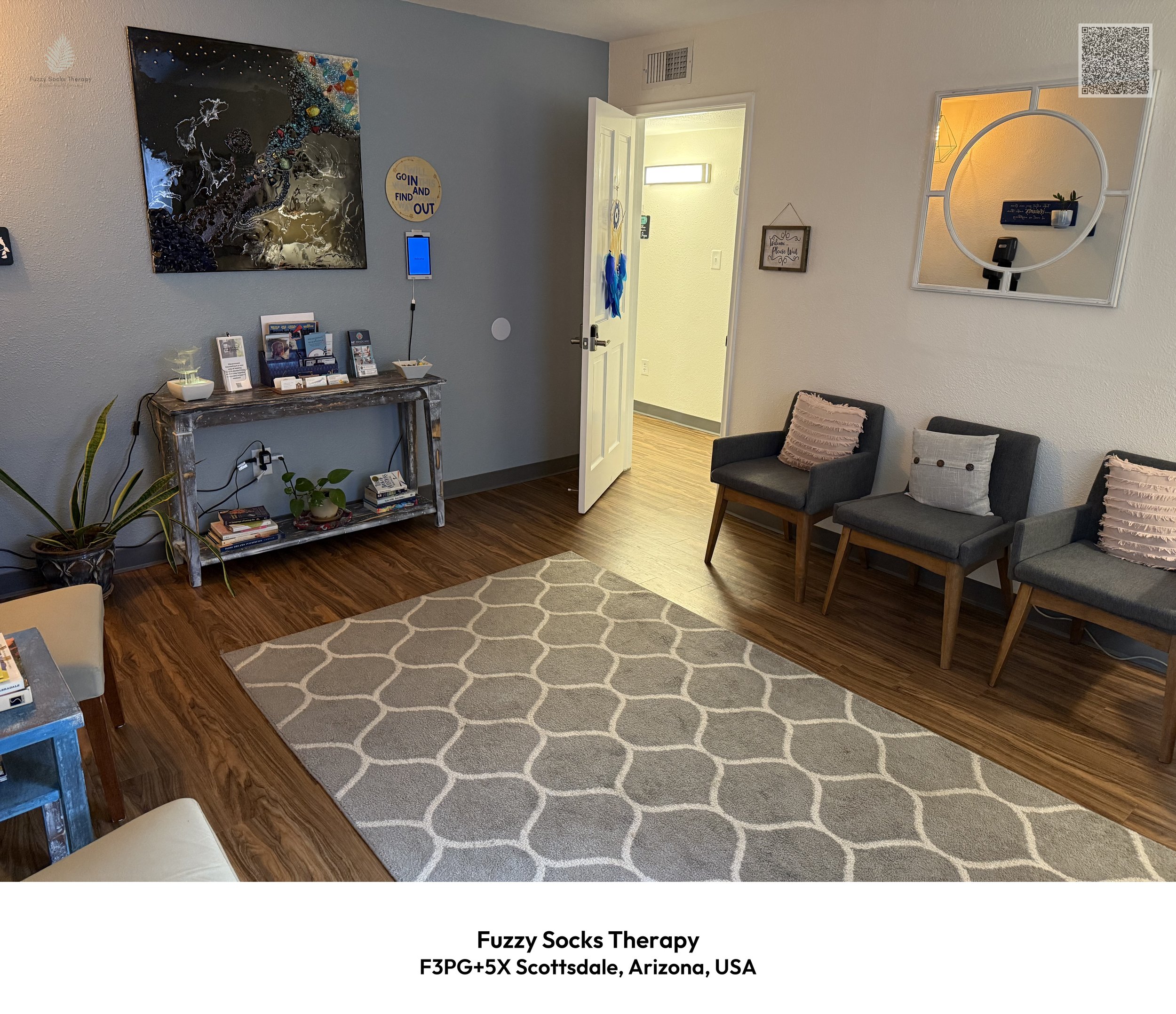
Neurodivergent Therapy in Scottsdale
Fuzzy Socks Therapy is located in Scottsdale, Arizona, with in-person and online therapy available. I work with neurodivergent adults and couples who want practical, affirming support without being told they need to change who they are.
In-person neurodivergent therapy is available at my Scottsdale office, and online therapy is available throughout Arizona, Colorado, Florida, and Nevada.